The organisation highlighted widespread corruption, debt bondage, forced labour, and systemic human rights violations faced by Bangladeshi workers throughout the migration process.
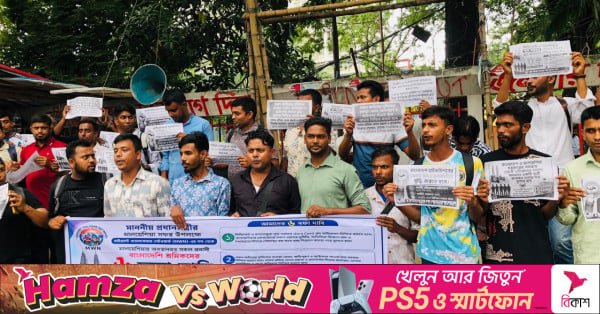
Members of the Migrant Welfare Network (MWN) form a human chain outside the National Press Club in Dhaka on 17 June 2026. Photo: TBS
“>

Members of the Migrant Welfare Network (MWN) form a human chain outside the National Press Club in Dhaka on 17 June 2026. Photo: TBS
The Migrant Welfare Network (MWN), an alliance of current and former migrant workers, has called on Prime Minister Tarique Rahman to reform migration governance and dismantle recruitment syndicates exploiting Bangladeshi workers in Malaysia, ahead of his first state visit to the country next week.
The organisation submitted a public letter to the Prime Minister’s Office today (17 June) after holding a human chain outside the National Press Club in Dhaka, Niranjan, a Malaysia returnee and MWN member, confirmed the development to The Business Standard.
In the letter, MWN described the Bangladesh-Malaysia migration corridor as one of the most economically significant labour migration routes in Asia, yet one that “continues to operate under a lawless syndicate system that enables exploitation, monopolisation and impunity.”

The organisation highlighted widespread corruption, debt bondage, forced labour, and systemic human rights violations faced by Bangladeshi workers throughout the migration process.
It alleged that despite Malaysia recruiting workers from 14 source countries, Bangladesh remains the only one subjected to a restrictive model dominated by a small group of selected manpower agencies.
MWN said the syndicate-based system has artificially inflated migration costs and trapped thousands of workers in debt bondage for years. Many workers pay up to Tk6,00,000 to secure jobs in Malaysia, despite the officially approved migration cost being around Tk78,990. To finance the journey, many take high-interest loans or mortgage family assets, leaving them vulnerable to exploitation.
“Without dismantling the syndicate system, no reform will be sustainable in this migration corridor. The syndicate system remains the central driver of corruption, worker exploitation, excessive migration costs and repeated governance failures,” the letter stated.
Among its key demands, MWN called for replacing the existing Bangladesh-Malaysia Memorandum of Understanding with a binding Bilateral Labour Agreement, eliminating recruitment syndicates, regularising undocumented Bangladeshi workers in Malaysia, recovering unpaid wages, ending passport confiscation and forced labour, strengthening services at the Bangladesh High Commission in Kuala Lumpur, and establishing a transparent grievance mechanism under the Prime Minister’s Office.
About The Author