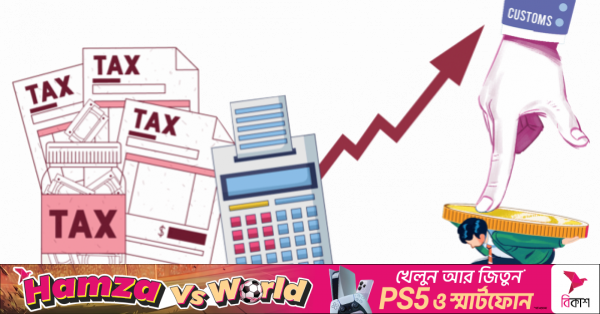
The era of customs authorities arbitrarily determining the value of imported consignments instead of accepting buyers’ declared and actual transaction values is set to end.
To this effect, the National Board of Revenue (NBR) has issued an order, under which internationally recognised websites and journals will be used as valuation benchmarks.
Experts believe the move will not only prevent the practice of imposing additional taxes through overvaluation but will also reduce opportunities for revenue evasion through false declarations. As a result, consumers may be spared an estimated additional Tk15,000 crore in costs annually.

According to the NBR order, if the value information provided in import documents submitted by importers is found to be consistent with information from internationally recognised and independent pricing publications, websites or journals such as S&P Global Platts, Independent Commodity Intelligence Services (ICIS), London Metal Exchange (LME), Shanghai Metals Market (SMM), Bloomberg, International Sugar Organization (ISO), or similar publications, the importer’s declared value may be accepted as the correct transaction value for customs assessment purposes.
A senior NBR official involved in the budget process, speaking to The Business Standard on condition of anonymity, said, “The journals mentioned cover nearly 95% of imported goods.”
The websites and publications in question regularly update commodity prices and are widely used around the world as benchmarks for determining transaction values.
Businesspeople say Bangladesh customs authorities often continue to assess goods based on reference prices established when global prices were high. Although prices frequently return to normal levels or decline after temporary increases, customs authorities continue to use the higher reference values, forcing importers to pay additional duties and taxes, which ultimately raise consumer prices.
At the same time, if an importer purchases goods at a price higher than the reference value, that higher value must now be declared, reducing opportunities for under-invoicing.
NBR Chairman Abdur Rahman Khan told The Business Standard, “The new decision will reduce opportunities for both under-invoicing and over-invoicing. Assessment based on transaction value will ensure the government receives the correct amount of revenue, while reducing the scope for complaints from businesses.
“A major issue under the current valuation system is the large number of litigations and appeals. These disputes and appeals will decline significantly.”
The NBR chairman said, “This will provide substantial relief to businesses.”
Business leaders and experts have described the initiative as “groundbreaking”. They argue that assessments based on actual prices will reduce the likelihood of higher costs for consumers while also limiting opportunities for money laundering.
According to recent estimates, importers paid nearly Tk30,000 crore in additional duties over the past two years because customs authorities assessed imported consignments at values higher than their actual import prices. Experts believe consumers ultimately bore this additional cost.
They also argue that the practice is unscientific and inconsistent with the principles of the World Trade Organization (WTO).
For years, businesses have opposed customs assessments based on reference values, instead demanding that import duties be calculated using actual transaction values.
The BNP-led political government has now moved to fulfil that long-standing demand.
Salman Karim, managing director of Confidence Infrastructure Ltd, one of Bangladesh’s leading business conglomerates, said, “The decision to assess import consignments based on transaction values will be transformative for us.
“It will create opportunities to reduce both our costs and the harassment we face.”
Snehasish Barua, a chartered accountant and director of SMAC Advisory Services Limited, told TBS, “This decision will reduce costs and harassment for compliant businesses, while non-compliant operators will face greater scrutiny.”
Calling it a “landmark initiative”, he said, “Whenever we attend hearings, we see that most litigation revolves around valuation issues. These disputes will now decline significantly, and the government will receive the correct amount of revenue.”
Current valuation system can increase taxes by 50%
The total tax incidence on polypropylene fibre (PP fibre) – the main raw material used to manufacture geobags – including duties and taxes, is approximately 28%.
A Confidence Group company manufactures geobags. Salman Karim told TBS that the average import price of PP fibre over the past two and a half years has been around $1,200 per tonne. However, customs authorities assessed imports using a reference value of $1,550 per tonne, roughly 30% higher than the actual price.
He said, “Although actual import prices have increased recently due to developments in the Middle East and other factors, they still remain below $1,350 per tonne. Yet importers have been paying duties based on the inflated valuation used over the past two and a half years.
“As a result, importers in this sector have been paying around Tk70 crore in additional import taxes every year.”
He added, “This increased our costs and pushed up product prices.”
Faridur Rahman, a small importer based in Mirpur who imports switches, sockets and other electrical and electronic products, told TBS, “The value used by the NBR for assessing switches and sockets is around 50% higher than the actual value, which significantly raises our costs.”
“We have no choice but to pass these additional costs on to consumers because our profit margins are already very small,” he said.
A new report titled “Tax Policy for Development: A Reform Agenda for Restructuring the Tax System,” prepared by the National Task Force for Tax Reforms, found that overall import values in FY24 and FY25 were increased by up to 15% compared with importers’ declared transaction values.
While the report does not quantify the additional revenue collected through loading, importers estimate they paid up to Tk15,000 crore extra annually, or roughly Tk30,000 crore over two years. According to NBR data, more than Tk2 lakh crore in import taxes was collected during those two fiscal years.
Accessing the data will cost money
NBR sources said access to the international databases mentioned in the order will require paid subscriptions, with total annual costs estimated at around Tk2 crore.
The NBR chairman said the subscription process for these platforms has already begun.
However, another source said discussions on obtaining subscriptions have been ongoing for the past year with little progress, largely due to bureaucratic delays.
The NBR official said, “Importers themselves may subscribe to these databases and provide the data to the NBR, and the NBR will accept it.”
However, the cost could be prohibitively high for small importers.
The official suggested another option: “Instead of individual businesses subscribing separately, their trade associations could obtain subscriptions and share access among members.”
“What we need is access to the data. If importers can obtain access themselves and share it with us while our own process is delayed, we will accept it,” he said.
About The Author