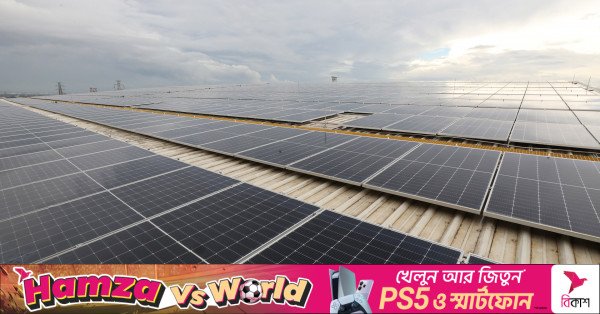
Highlights:
- Industry experts project 2,000MW of new rooftop solar capacity within two years
- Analysts see potential for Pakistan- or Vietnam-style solar boom in Bangladesh
- Rooftop solar can generate electricity at around Tk3 per unit, far below grid power costs
- Industries expected to accelerate solar adoption due to strong cost advantages
- 4,000MW of industrial rooftop solar could save around Tk5,000 crore annually in power subsidies
- Every 500MW of rooftop solar could save about $20 million in import costs
For years, Bangladesh’s solar ambitions have lived in policy documents and ministerial speeches. This budget has changed that.
By withdrawing all import duties on solar panels, inverters, lithium batteries, DC cables, and mounting structures – cutting the effective duty burden from around 20% to zero – the government has removed the single biggest financial obstacle to rooftop solar adoption in the country.

Customs and regulatory duties on all other components are slashed to zero, battery storage duty falls from 61.8% to zero, and commercial solar investment gets a full income tax holiday until 2035. Retail and industrial consumers who install solar will receive a 5% rebate on their electricity bills.
The numbers tell the story of what changes. Installing one megawatt of rooftop solar previously cost Tk3.5-4 crore. It will now cost Tk2.75-3 crore, a 25-30% reduction. A one-kilowatt-hour storage battery that costs $300 will now cost $160. The foreign currency component of a one-megawatt installation falls by roughly $40,000, equivalent to nearly Tk50 lakh.
“We have only dreamt in the past and confined ourselves to rhetoric,” said Masudur Rahim, CEO of Omera Solar, the country’s largest panel manufacturer. “Now the government has taken practical moves.”
Industry insiders and energy analysts are now projecting 2,000 megawatts of new rooftop solar capacity within two years, with the potential for a Pakistan-Vietnam-style boom that transforms Bangladesh’s energy mix within a decade.
How Pakistan and Vietnam did it, why Bangladesh can too
The precedents are instructive. Pakistan’s rooftop solar capacity has surged to an estimated 34,000 megawatts, with around 25,000 megawatts of that in decentralised, grid-connected installations.
The trigger was the Russia-Ukraine war in 2022, which drove up fuel prices and made imported fossil fuels unaffordable. The government responded by cutting solar import duties to zero. The result: the solar share in its energy mix jumped from 2.9% in 2020 to 32.3% in 2025. One in four Pakistani households now uses solar in some form. It helped Pakistan save billions of US dollars in fuel imports.
Vietnam’s case was equally dramatic. Its solar sector grew from virtually zero in 2018 to over 19,000 megawatts by the end of 2025, making it Southeast Asia’s largest solar producer, driven by rising grid costs and attractive tariffs.
Bangladesh now has comparable triggers. Grid electricity costs industries Tk11.56 per unit during off-peak hours and Tk16 during peak hours. With duty waivers, rooftop solar can deliver electricity at Tk3 per unit over a 20-year panel lifespan, roughly one quarter of the grid price. The economics are no longer marginal. They are compelling.
“I think industries with available rooftop or unused land space will rush to install solar,” said Shafiqul Alam, lead energy analyst at the Institute for Energy Economics and Financial Analysis (IEEFA). “Rural consumers with the financial means are also likely to follow.”
The knock-on effects extend to the national balance sheet. Rahim of Omera Solar calculates that 4,000 megawatts of industrial rooftop solar, which he considers achievable within five years, would reduce grid dependency by the equivalent amount, saving approximately Tk5,000 crore annually in power subsidies that currently run at Tk4-6 per unit.
On the foreign exchange side, every 500 megawatts of rooftop solar installed saves roughly $20 million in import costs. At 1,000 megawatts, that figure doubles.
Of the government’s 10,000-megawatt solar target over five years, Rahim believes 4,000 megawatts is achievable in industrial rooftops alone, with the remaining 6,000 megawatts from ground-mounted and utility-scale projects.
“Things will be significantly visible within two years,” he said, adding that unreliable grid supply in district and rural areas will push residential consumers toward solar as well.
The risk that could unravel it all
There is one caveat that both analysts raise with equal urgency: quality.
Zero duties mean open borders for solar components and not all components are equal. Substandard panels, counterfeit batteries, and poorly rated inverters have damaged solar adoption in many markets, leaving consumers with systems that underperform or fail within years of installation, discouraging further uptake precisely at the moment momentum is building.
“Sreda and BSTI must ensure quality standards so that consumers are not heartbroken and get discouraged about solar,” said Alam of the IEEFA. If regulators cannot enforce quality at the import stage, the duty waiver that was meant to democratise solar could instead flood the market with cheap, unreliable equipment and turn Bangladesh’s solar moment into a cautionary tale.
The policy is right. The economics is right. The timing, given energy supply uncertainty and rising grid costs, could not be better. Whether Bangladesh seizes this moment or wastes it will depend not on duty cuts but on the authorities who ensure that what arrives at Chattogram port is worth installing on a factory roof.
About The Author