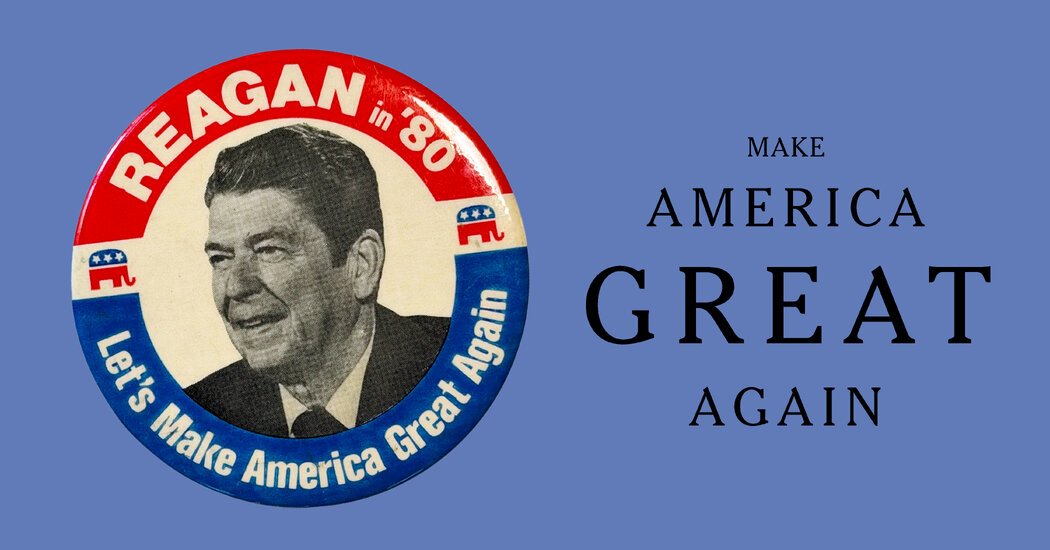


Yes, it’s a campaign slogan, an ideological catchphrase, a monument of political branding rather than rhetorical art. Some readers may wince at seeing these four words in a collection of important American sentences; others may suspect trolling or trickery. But it’s hard to deny the impact of this declaration, which predates the 2016 presidential election and resonates beyond the outrage cycles of the past decade.
Unpack the MAGA acronym, detach the words from the person of Donald Trump (who was not the first presidential candidate to invoke them) and you find a sentiment nearly as old as the Republic itself. Some versions of the national story see American history as an epic of progress, bending toward a future that will redeem the injustices of the past. These four words evoke a persistent and powerful counternarrative of loss, decline and betrayal. They look to the past to redeem the failures of the present.
It’s both and neither. Unlike Reagan’s slogan or Clinton’s revision of it, Trump’s mantra is less a statement of shared duty than a mutual evasion of responsibility. Whoever says “Make America great again” is logically and grammatically counting on someone else to do the job.
What is the job, though? Shifting the focus from grammar to semantics reveals a fresh set of complications. Each of the last three words opens a can of worms. What is America? How is it great? When was the before implied in “again”?
Nostalgia isn’t the exclusive property of the political right, but the structure of feeling that underlies much of modern American conservatism can be found in the impulse to restore something essential that has been lost.
In 1982, the year after Reagan’s inauguration, Merle Haggard released the single “Are the Good Times Really Over (I Wish a Buck Was Still Silver),” which would rise to No. 2 on the Billboard country charts. The song, a somber and defiant anthem laced with Haggard’s characteristic irony, is a succinct compendium of anti-progressive cultural complaints.
The lyrics conjure a time before Elvis Presley and the Beatles, when “coke was still cola and the joint was a bad place to be.” Along with drugs and rock ’n’ roll (and maybe also paper currency), came an erosion of traditional gender roles and responsibilities. In the old days, “a man could still work and still would” and “a girl could still cook and still would.” You get the picture.
The song doesn’t call out a specific political party for praise or censure (though it does mention Richard Nixon’s dishonesty), but even as Haggard casts his gaze back to the good old days, he also channels a white working-class populism that would increasingly find a home in the Republican Party.
Hearing an appeal to lost greatness and vanished freedom, an American voter or radio listener might infer an argument about how the standing of white men was eroded by civil rights legislation, post-1965 immigration and feminism — by the social changes of the 1960s and ’70s.
In the years since “Are The Good Times Really Over,” other stories have been stirred into the mix: about the disappearance of factory jobs; the decline of labor unions; the hollowing out of small towns by globalization; stagnant wages; the opioid crisis; forever wars.
The list goes on. The meaning of “make America great again” is far from stable. Repurposing Reagan’s language, Clinton emphasized the erosion of economic opportunity and the faltering of the middle class, and tried to narrow the gap between the idealism of the ’60s and the nostalgia that followed.
Trump, in turn, transformed a vague, hopeful lament into a set of specific accusations — against “wokeness,” D.E.I., Marxism and other manifestations of liberal waywardness. MAGA is sometimes described as a politics of resentment, but it is also a catechism of blame, one that often makes explicit the racial and nationalist animus that earlier iterations of conservatism had tucked into the subtext.
As MAGA has evolved from an inchoate set of feelings into a governing program, it has rewired the polarities of American politics. Conservatism has been radicalized. Especially in his second term, Trump has tried to carry out what his former adviser Steve Bannon called “the deconstruction of the administrative state” and the wholesale disruption of nearly every institution in American life, from academia to the news media to the courts. His administration has also tried to roll back many of the changes in the realms of race, gender and sexuality that liberalism had celebrated as progress.
In response, liberalism has found itself adopting positions that can only be called conservative. Opponents of the status quo have become its passionate defenders. The default language of center-left politics used to be all about hope, change and the best America that was still to come. Trump’s opponents are now just as likely to talk about guardrails and traditions, about norms and procedures and the rule of law, about the need to restore the way things used to be.
Or, as some shrewd future leader will surely put it, in so many words or not, the need to make America great again.
Six sentences that shaped the American story:
About The Author