The initiative follows the initial success of AI-based traffic monitoring in Dhaka
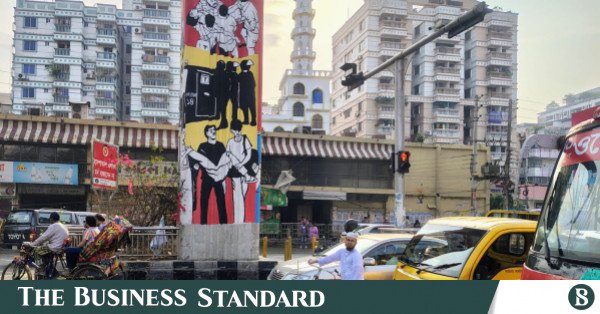
At a red light in front of Hotel Intercontinental on Monday, cars and motorcycles wait in orderly fashion behind the stop line, while a battery-run autorickshaw sits far ahead – well past the signal, almost claiming its own front row. Photo: TBS
“>

At a red light in front of Hotel Intercontinental on Monday, cars and motorcycles wait in orderly fashion behind the stop line, while a battery-run autorickshaw sits far ahead – well past the signal, almost claiming its own front row. Photo: TBS
Highlights:
- Chattogram plans AI traffic management at 53 major junctions
- Project cost estimated at around Tk500 crore
- AI signals will adjust timings using real-time traffic data
- Emergency vehicles will receive faster, prioritised road access
- Most existing traffic signals remain broken or non-functional
- Experts say maintenance and enforcement remain equally essential
Chattogram City Corporation has planned an AI-based smart traffic management project for 53 key junctions in the port city at an estimated cost of around Tk500 crore.
The planned coverage includes at least 46 traffic points where existing signals are now mostly non-functional, according to field visits.

The “Smart Traffic Management” project is now at the Development Project Proposal (DPP) stage and will be sent to the Local Government Division after finalisation, officials said.
The initiative follows the initial success of AI-based traffic monitoring and automated law enforcement in Dhaka. The city corporation has taken the move as Chattogram continues to struggle with long-running congestion, broken traffic signals and manual traffic control.
Infograph: TBS
“>

Infograph: TBS
How the system will work
Abu Sadat Mohammad Tayab, supervising engineer of Chattogram City Corporation, told TBS that once introduced, the AI-based smart signal system will be able to analyse traffic pressure on roads in real time.
“Signal timing will be adjusted automatically based on vehicle density, helping reduce congestion as well as time and fuel waste,” he said.
The system will also make movement easier for emergency vehicles, including ambulances and fire service vehicles, he added.
Tayab said rapid urbanisation, population growth and expanding commercial activity have put heavy pressure on the city’s road network.
“As a large part of the current traffic system still depends on manual control, vehicle movement cannot be managed effectively. The project has been taken to develop a modern, technology-based integrated traffic management system,” he said.
Under the project, 53 important junctions in the city will be brought under the smart traffic system, he said.
These junctions will have integrated management for buses, trucks, private cars and motorcycles, as well as rickshaws, vans and bicycles. The system is expected to reduce congestion and improve road discipline and safety, he added.
Traffic police to coordinate implementation
Chattogram Metropolitan Police Traffic North Division Deputy Commissioner Nesar Uddin Ahmed told TBS that the traffic signal system falls mainly under the city corporation.
“Installation and maintenance of signal lights are also their responsibility. They have now taken up a project on a modern traffic system. The project is being coordinated with traffic police,” he said.
Although the city corporation has taken the project, traffic police will be responsible for its implementation, he added.
Signals broken at key junctions
At present, the city’s traffic system presents a different picture.
Most traffic signal lights installed across Chattogram have remained out of order for years. As a result, instead of a modern signal system, traffic police still control vehicles mainly through hand signals.
Field visits show that most signal lights are non-functional at 46 key traffic points planned under the project, including Agrabad Access Road, Lalkhan Bazar, Kazir Dewri, GEC intersection, Gate No 2, Muradpur and Bahaddarhat.
In some places, there are no signal lights. In others, control boxes remain but the lights do not work. At many points, signal poles and related infrastructure have become worn out due to lack of maintenance.
As a result, traffic police face extra pressure in controlling vehicles. At busy intersections, manual control often leads to congestion, disorder and confusion among drivers.
Expert warns technology alone not enough
Engineer Delwar Majumder, former president of the Institution of Engineers, Bangladesh (IEB), Chattogram Centre, told TBS that the project could be a significant step towards easing Chattogram’s long-standing traffic congestion if implemented properly.
However, he said technology alone would not solve the problem without effective maintenance, enforcement of traffic laws, improvements to public transport and greater public awareness.
“AI technology has many positive sides, but it also has some side effects. At least three people I know have faced false cases because of AI-based surveillance systems. So the risk of harassment must also be considered before using such technology,” he said.
“It is important to first ensure how such possible problems will be addressed and how prepared we are to manage this kind of technology,” he added.
Delwar said the city’s road management remains unplanned in many areas.
“Pedestrians do not have enough footpaths, and many existing footpaths are occupied. Road management, footpaths, traffic discipline and traffic infrastructure problems must be addressed first,” he said.
“The real benefits of an AI-based traffic system can be achieved only if these issues are fully addressed and coordinated,” he added.
About The Author