72% say political parties are not taking adequate steps for women’s representation
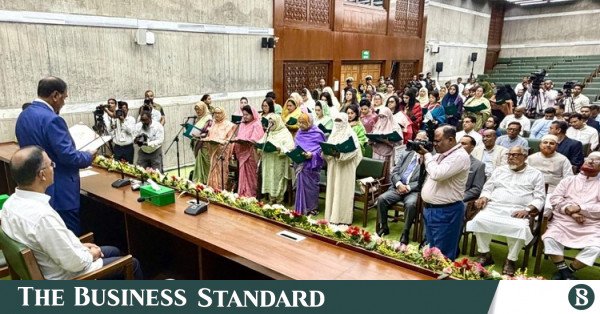
Forty-nine newly elected members of parliament from reserved women’s seats in the 13th National Parliament took oath in the presence of Prime Minister Tarique Rahman. Photo: Prime Minister’s Office
“>

Forty-nine newly elected members of parliament from reserved women’s seats in the 13th National Parliament took oath in the presence of Prime Minister Tarique Rahman. Photo: Prime Minister’s Office
Despite a legal obligation for political parties to ensure 33% representation of women at all levels by 2030, progress in implementation remains limited, raising concerns over women’s meaningful participation in politics.
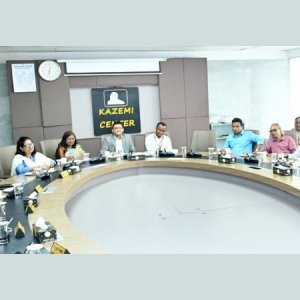
The findings were presented at a divisional dialogue held in Dhaka today (8 June), where a study titled “Political Parties’ Position on the Representation of the People Order (RPO)” was shared. The event was jointly organised by Wave Foundation and ActionAid Bangladesh.
Conducted under the GRIP Project part of UN-supported electoral initiatives BALLOT and DRIP the research gathered insights from 191 stakeholders across 11 districts in six divisions. The research was carried out by Sanaia Fahim Ansari, while Consultant Mansura Akhtar presented the study findings at the event.

While 87.3% of respondents were aware of the requirement for women’s representation, 72% said political parties are not taking adequate steps to implement it. Concerns were also raised about the capacity of the Bangladesh Election Commission, with only 1.4% of respondents believing it has sufficient ability to enforce compliance.
The study identified several structural and social barriers limiting women’s participation. Around 60.6% cited patriarchal political culture as a major obstacle, followed by lack of political commitment (56.3%), family and social pressures (49.3%), and weak internal democracy within parties (45.1%).
For young women, safety concerns, including fear of online harassment and insecurity, emerged as the most significant deterrents. Limited opportunities within party structures and financial constraints further restrict their engagement.
Participants stressed that women’s political representation must go beyond quota-based systems and reserved seats. Instead, they called for inclusive participation in decision-making bodies, including nomination committees.
Key recommendations included regular audits of political parties by the Election Commission, mandatory publication of gender-disaggregated data, and incentives for parties nominating more women in direct elections. Reducing nomination fees and introducing structured mentorship programmes were also proposed.
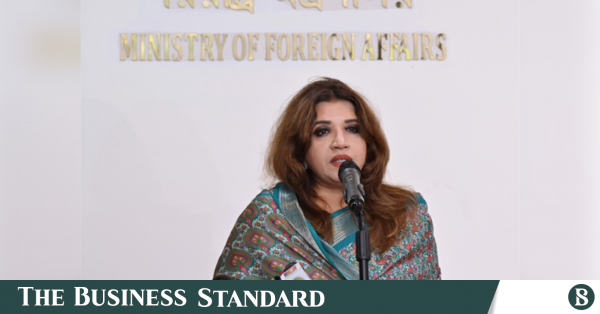
Speaking at the event, Tapati Saha, Programme Manager, Gender Responsive Governance, UN Women Bangladesh said UN Women’s commitment to continuing collaborative efforts with all stakeholders to strengthen gender-responsive and inclusive democratic structures.
Chief Guest Election Commissioner Abdur Rahmanel Masud stated that the Bangladesh Election Commission is responsible not only for organising and conducting elections but also for ensuring that the will and representation of the people are reflected in the democratic process.
He encouraged organisations and individuals working on women’s rights and political participation not to lose hope and emphasised the need for collective efforts to build a more inclusive political environment.
Farah Kabir, Country Director of ActionAid Bangladesh, said: “Our objective is not simply to identify the shortcomings or limitations of the Election Commission, political parties, or the Representation of the People Order. Rather, it is to develop a sustainable course of action that enables all stakeholders to contribute positively from their respective positions in the years ahead.”
Representatives from the Bangladesh Nationalist Party (BNP), National Citizen Party (NCP), and AB Party, along with representatives from the Election Commission, United Nations agencies, civil society organisations, media, legal professionals, researchers, and youth groups, participated in the open discussion.
Participants agreed that women’s political representation should not be limited to reserved seats or quotas alone. Instead, their effective participation must be ensured at every level of decision-making. To achieve this, political commitment, social awareness, and institutional reform must be advanced simultaneously.
About The Author