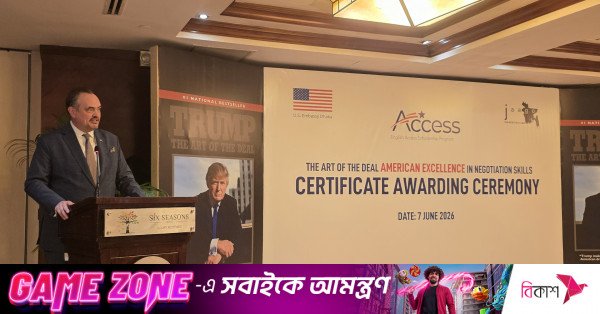
The United States is seeking to deepen future business-to-business engagement with Bangladesh by equipping young professionals with leadership and negotiation skills aligned with American business practices, US Ambassador to Bangladesh Brent T Christensen has said.
Speaking at the closing ceremony of a four-day leadership training programme in Dhaka today (7 June), the ambassador said a stronger understanding of US negotiation culture could help expand economic and commercial cooperation between the two countries.
“It is really helpful to work with and negotiate against people who understand how we Americans negotiate,” he said, expressing hope that such initiatives would pave the way for stronger business partnerships and increased investment flows.

The programme titled The Art of the Deal: American Excellence in Negotiation Skills trained 60 graduates of the US-funded Access English programme from Dhaka, Chattogram and Sylhet.
It was conducted with support from US English Language Specialist Joanne Munisteri and focused on communication, leadership and negotiation techniques.
Christensen highlighted key elements of American negotiation style, including preparation, clear communication, strategic thinking and mutually beneficial outcomes.
“Successful negotiation is not just about making deals, it is about building relationships based on trust, solving problems and creating new opportunities,” he said.
Referring to the 2016 US presidential election and President Donald Trump’s book The Art of the Deal, the ambassador said the principles outlined in the book influenced perceptions of Trump’s negotiation approach and offered lessons applicable beyond politics.
He said such skills are increasingly important as Bangladesh and the United States expand cooperation in trade, investment and private sector engagement.
The ambassador added that international businesses seek reliable local partners who understand global commercial practices, and stronger people-to-people connections can further support economic collaboration.
The programme reflects continued US emphasis on youth development and educational exchange as part of its engagement with Bangladesh. Beyond language training, US-supported initiatives increasingly focus on leadership, entrepreneurship and workforce readiness to prepare young Bangladeshis for global opportunities.
The United States remains one of Bangladesh’s largest export destinations and a key source of foreign direct investment, particularly in energy, technology and manufacturing sectors, with officials from both countries consistently stressing the need to expand trade and private sector cooperation.
About The Author