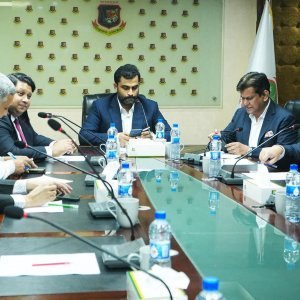
Acting on the directives of Prime Minister Tarique Rahman, the government has already established a dedicated cell under the Prime Minister’s Office (PMO), headed by Rashed Al Mahmud Titumir, prime minister’s adviser on finance and planning
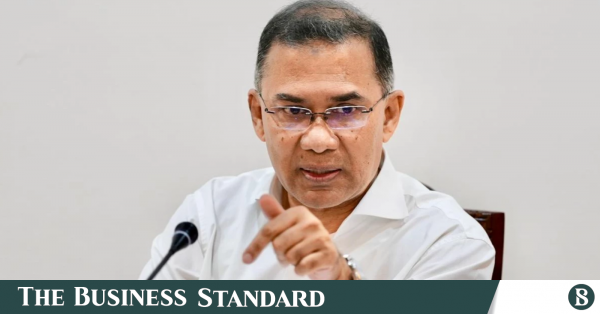
Prime Minister Tarique Rahman. Photo: Courtesy
“>

Prime Minister Tarique Rahman. Photo: Courtesy
Highlights:
- BNP ends direct constituency funds for MPs
- PMO cell will review and oversee project proposals
- MPs can propose projects but cannot control funding
- Projects must match government priorities and development goals
- Ministries must implement projects and report monthly progress
- Experts say reform could reduce corruption and abuse
The BNP government plans to replace the previous system of direct constituency allocations for MPs with a centralised mechanism under the Prime Minister’s Office, allowing lawmakers to propose development projects while removing their direct control over funds.
Acting on the directives of Prime Minister Tarique Rahman, the government has already established a dedicated cell under the Prime Minister’s Office (PMO), headed by Rashed Al Mahmud Titumir, prime minister’s adviser on finance and planning.

PMO officials said lawmakers will submit written proposals outlining the development projects they pledged during elections or consider necessary for their constituencies.
They said projects proposed by lawmakers will not be approved automatically. Instead, they must align with the government’s broader development priorities and policy objectives.
Infograph: TBS
“>
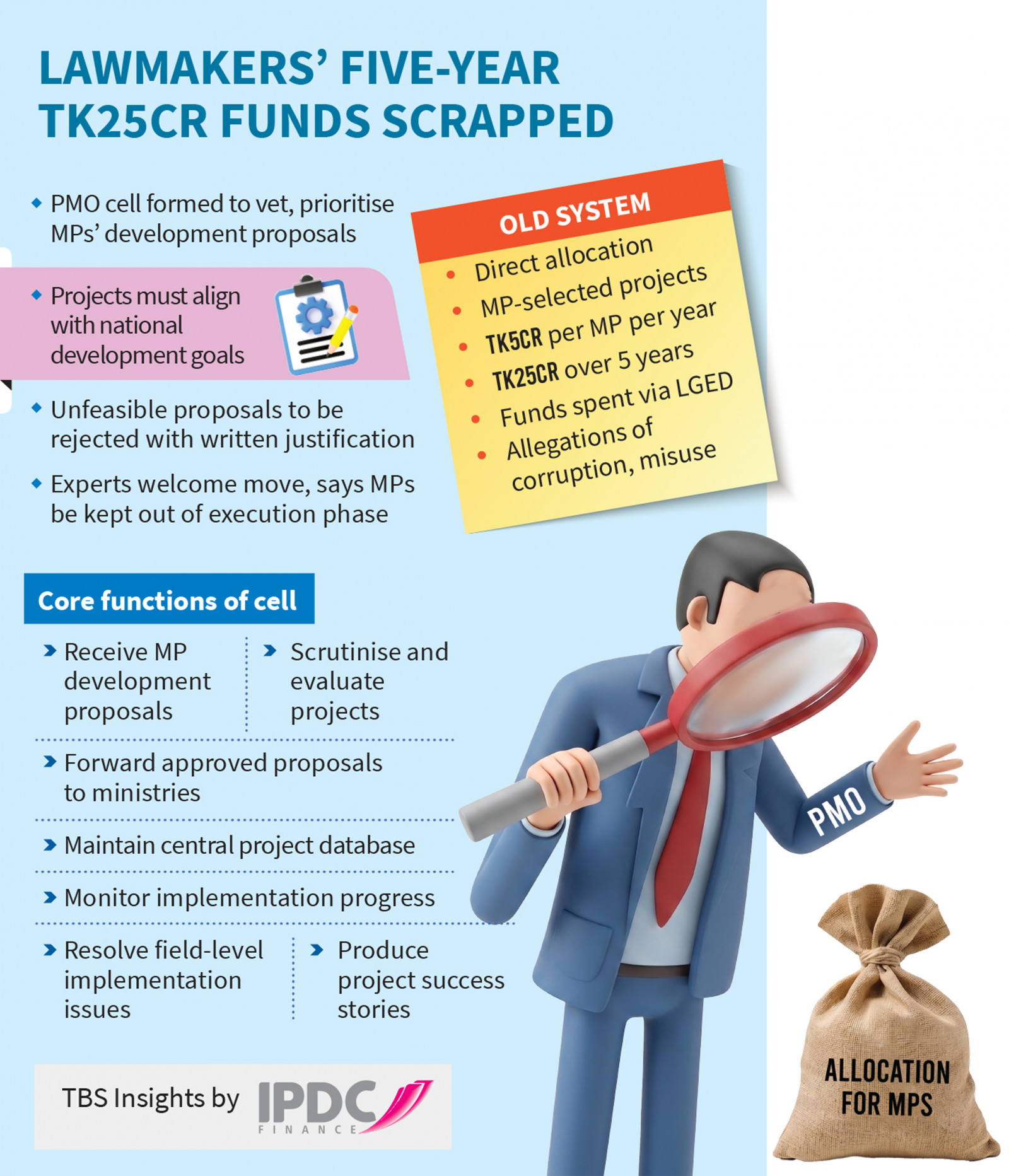
Infograph: TBS
Under the Awami League government, lawmakers received annual allocations to fulfil election pledges and finance infrastructure projects in their constituencies.
The funds were spent through the Local Government Engineering Department (LGED), often on projects chosen by the MPs themselves, a system that faced allegations of corruption and abuse of power. In FY2024-25, each MP was allocated Tk5 crore annually under the scheme.
Experts believe the initiative could help curb corruption involving MPs and their close political associates at the local level. They said its success will depend on preventing lawmakers and local party activists from influencing the implementation process.
Progress report every month
Officials said the cell will scrutinise the proposals under a prescribed framework before forwarding eligible projects to the relevant ministries. The PMO has already prepared a standard operating procedure (SOP) that will govern the assessment and selection process.
Once approved by the cell, the selected proposals will be sent to relevant ministries, which will undertake and implement the projects through subordinate agencies. Ministries will be required to report implementation progress to the cell by the fifth day of every month.
Any ministry or division encountering obstacles during implementation must also inform the cell, which will be responsible for resolving the issues, according to PMO officials.
Ministries receiving project proposals from the cell must report actions taken within seven days. If a proposal is deemed unfeasible, the relevant ministry must provide a reasoned explanation and notify the cell as quickly as possible.
Earlier, soon after taking office, the BNP parliamentary party decided to withdraw the duty-free vehicle import facility for MPs. The National Board of Revenue is expected to formally abolish the privilege in the upcoming budget.
According to sources at the Prime Minister’s Office, under the “Priority Rural Infrastructure Development Project”, the Awami League government’s last budget allocated Tk5 crore annually to each MP for infrastructure development in their constituencies.
Except for 20 MPs representing constituencies within city corporation areas, the remaining 280 elected MPs were entitled to Tk25 crore over a five-year parliamentary term.
Earlier, after the Awami League first formed government in 2009, each MP received Tk15 crore over five years for constituency infrastructure development.
Following the 10th parliamentary election in 2014, the allocation was increased to Tk20 crore per MP. The same amount was allocated after the 2018 general election.
Lawmakers could spend the funds on projects of their choice, including roads, bridges, culverts, markets and ferry terminals. MPs were allowed to determine which roads, bridges, culverts and markets would be built in their constituencies. The LGED then implemented the projects and disbursed the funds according to the lists submitted by the lawmakers.
Dedicated cell at PMO
A meeting was recently held at the Cabinet Division to operationalise the newly formed “Cell for the Implementation of MPs’ Commitments and Expected Development Programmes”.
The meeting decided that, in the absence of Rashed Al Mahmud Titumir, the principal secretary to the prime minister would serve as head of the cell.
The PMO has instructed ministries, divisions and government agencies to review and verify development proposals submitted by MPs since the BNP assumed office on 18 February, and then forward eligible proposals to the cell.
According to the minutes of a meeting held on 23 May, Titumir said the cell had been established under the Prime Minister’s Office to ensure the swift, effective and orderly implementation of development programmes promised by MPs and expected by the public.
He said the cell would play a key role in ensuring transparency and accountability in development activities, strengthening coordination among ministries and divisions, and resolving field-level implementation problems without delay.
What experts say
Describing the initiative as a positive step, Iftekharuzzaman, executive director of TIB, said if implemented properly, the decision would be highly constructive and consistent with the current government’s election manifesto.
“For years, the practice of allocating funds directly to MPs for constituency development has enabled corruption and abuse of power by lawmakers and their close local associates under the guise of development,” he told The Business Standard.
He added that proposals submitted by MPs should be scrutinised through the cell, while project implementation must remain the responsibility of the relevant ministries. “It should also be ensured that MPs have no involvement in the implementation stage.”
He further said that all procurement related to the projects must comply with the Public Procurement Act and relevant regulations.
“If the implementation process is not insulated from partisan influence, particularly from local party leaders and activists, there is a real risk that the same irregularities and corruption seen in the past will simply be repeated,” he added.
However, Iftekharuzzaman cautioned that the government must remain vigilant about the sources of risk to ensure that a well-intentioned reform driven by political goodwill does not ultimately become “old wine in a new bottle”.
Criteria for evaluating proposals
According to the SOP formulated for the evaluation, assessment, any project must be aligned with the government’s electoral commitments and national development goals.
The assessment process will examine how effectively a proposed project can contribute to poverty reduction among disadvantaged communities and residents of remote areas.
It will also evaluate the project’s potential to generate direct and indirect employment opportunities for local people during and after implementation.
In addition, proposals will be assessed on their likely impact on local agriculture, small industries and businesses. Evaluators will also consider the extent to which women, children, older people and persons with disabilities are expected to benefit from the project.
The review process will further analyse the project’s contribution to improving healthcare, education, transport connectivity and sanitation services.
Projects proposed by MPs will not be approved if similar work is already being implemented in the same area under another government scheme.
Sources at the PMO said it will establish a database to collect, compile and preserve information on development projects promised by MPs or sought by their constituents.
The office will conduct preliminary screening, determine the necessity of proposed schemes, assess their feasibility and prioritise them based on public interest before forwarding them to the relevant ministries and divisions for implementation.
Another key responsibility of the cell will be to ensure the implementation of approved projects through effective monitoring and oversight.
The cell will also prepare success stories highlighting projects implemented in response to proposals. These reports will document the impact of completed schemes, their contribution to public welfare achieved through implementation.
About The Author