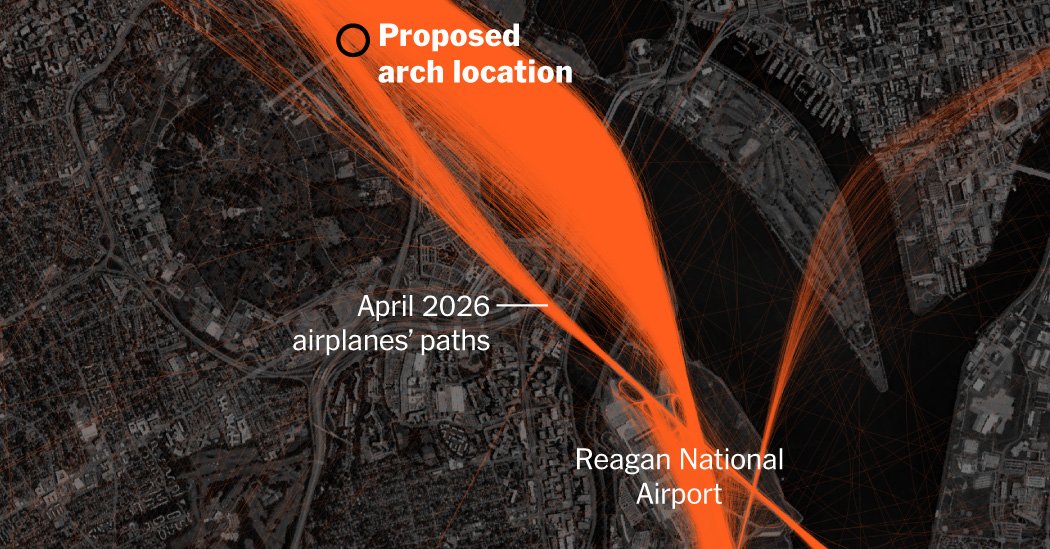
The mammoth triumphal arch President Trump wants to build would sit under one of the most complex sections of the national airspace — directly in the paths of flights in and out of Ronald Reagan National Airport and just a few miles from the site of a catastrophic midair collision last year.
Airplane traffic in April 2026
The Trump administration said on Thursday that the Federal Aviation Administration had compiled preliminary findings from an initial review of whether the proposed arch presented any risks to Washington’s airspace.
But the extent to which those findings, which have yet to be made public, will influence the administration’s plans to move ahead with construction as planned is uncertain. According to a New York Times analysis, the arch as currently planned would warrant further study under at least one F.A.A. guideline.
The F.A.A. had been looking into the administration’s plan for about a month to determine whether the proposed 250-foot structure — a height chosen to commemorate 2026 being the 250th year since American independence — would pose any hazard to flights in and out of Reagan National.
But in recent days, the National Park Service, acting on behalf of the Trump administration, appeared to change tack, quietly asking the F.A.A. to conduct a feasibility study — an advisory review that is normally preliminary and that, according to the F.A.A.’s own procedures, is usually given lower priority than official evaluations.
The reason for the new request, which administration officials defended as routine, was not immediately clear. Though the F.A.A. requires proposed structures over 200 feet to submit to a formal evaluation to determine their impact on local air traffic, feasibility studies are voluntary.
Some aviation experts said the administration’s decision to pursue one at this stage could indicate that possible problems had been identified with the height of the structure, which climbed from 250 feet in the initial filing to 259 feet in the feasibility study request, making the top of the arch sit 288 feet above sea level. In that case, they said, asking for an advisory study could be a strategy to avoid the potential black mark of having Mr. Trump’s pet construction project labeled a risk to flight safety.
It could suggest a project “ran into some issues and is more complicated than they had hoped,” said Michael O’Donnell, an aerospace consultant who previously worked as a senior F.A.A. official focused on air traffic safety.
The change in approach may reflect the sensitivity with which the federal government has approached potential risks in the airspace surrounding Washington since a midair collision last year that killed 67.
In the wake of that accident, in which an Army helicopter flew into a commercial jet 278 feet up in the air just southeast of Reagan National Airport, the F.A.A. shut down much of the surrounding sky to most helicopter traffic. It also instituted new prohibitions against pilots relying on “see and avoid” methods to avoid hitting planes going in and out of the airport.
Change in helicopter traffic
An airspace of unparalleled complexity
Should the arch proceed as planned, some aviation experts said it could be just the latest complication to befall a section of airspace already considered one of the nation’s most complicated.
Air traffic within a half-mile radius of the proposed arch location

Path of airplanes,
April 2026
Reagan National poses special challenges to pilots navigating the surrounding airspace. Planes cannot fly below 18,000 feet over the National Mall — a wide swath of Washington sitting just north of the airport — and the Naval Observatory, where the vice president lives, meaning that pilots routinely have to make tight turns when ascending from and descending to the airport to avoid them.
Flight restrictions for special events and security surrounding movements of government officials are frequent. Noise concerns in the surrounding metro areas push planes to tightly follow the Potomac River. And two of the airport’s three runways are short, which reduces the margin of error for flights landing or taking off — and contributes to the congestion of Runway 19, which is the nation’s busiest commercial runway.
Air traffic in April 2026 for Runway 19
The Reagan airspace has “just about every congested airspace issue that you can have,” said Dennis Tajer, a 737 pilot who is a spokesman for the American Airlines pilot union. “And we know the tragedy that happened — there’s room for error, but not much.”
A New York Times analysis of federal regulations, traffic patterns and flight procedures found that if the arch were built at the 250-foot height, it would penetrate what is known as the 40-to-1 obstacle clearance surface, an imaginary slope that begins at the departure end of the runway and represents a baseline standard for evaluating the impact of a nearby structure.
How the arch would penetrate the 40-to-1 slope
A structure that breaks through the surface does not necessarily pose a risk but requires further study to determine whether it can safely be built; whether changes such as reducing its height or adding obstruction lighting may be necessary; or whether the F.A.A. could make reasonable changes to flight operations and procedures to accommodate its construction as proposed.
The top of the arch as planned only slightly pushes through the bottom of the 40-to-1 slope — an altitude that virtually all planes would be well above when passing over the planned structure.
Still, some experts speculated that throwing an arch of such height and proximity into the mix could still prompt the F.A.A. to change flight procedures in and out of Reagan National in order to minimize risk. Such changes could affect the work of pilots and air traffic controllers, limit the number of planes allowed to take off or land, or change the maximum amount of weight they can carry.
“The accommodation may be just: Change other things that make it work,” said Scott Dunham, a former air safety investigator for the National Transportation Safety Board and former air traffic controller.
Buildings taller than the arch are farther from the airport
While the height of the planned arch would put it among the tallest structures in the airport’s vicinity, the structure wouldn’t break records. Both the Capitol building and the Washington Monument are taller, but they are both located in a no-fly zone. Memorial Circle, the planned location for the arch, is not.
The arch would also be dwarfed by some structures in Arlington, Va., including a pair of highrise apartments in the Crystal City neighborhood and the towers at Amazon’s new campus in the Pentagon City neighborhood, all less than a mile from the perimeter of Reagan National — and all of which were the subject of heated debate and intense F.A.A. scrutiny. But those structures are not under the main flight path in and out of the airport like the location of the planned arch is.
The nearest buildings that are over 250 feet and in proximity to the climb and descent paths to the airport are clustered in the Rosslyn neighborhood of Arlington, but those sit nearly a mile farther north than the arch, at a greater distance away from the airport.
Several of the buildings in Rosslyn have red obstruction lights to warn approaching pilots to steer clear, a common way to mitigate concerns about height.
Almost 1,700 public comments about the arch, nearly all in opposition, had flooded into the National Capital Planning Commission ahead of its Thursday meeting. Commenters protested issues ranging from its appearance to its significance to its potential impact on flight patterns.
The Department of the Interior, which oversees the National Park Service, said in a statement that feasibility studies, like the one the administration requested, were “standard practice as part of the compliance process.” It did not respond to questions about what prompted the study at this stage or what may have been communicated by the F.A.A. during the previous evaluation.
Under federal regulations, the arch must still complete the full evaluation to receive a final determination about whether it poses a hazard. But the F.A.A.’s determinations are not enforceable. A notice of hazard would typically prevent a commercial structure from obtaining insurance, a factor unlikely to prevent the president from proceeding if he so wishes.
Aviation experts and former F.A.A. officials interviewed by The Times said they trusted that any actions ultimately taken by the F.A.A. would not compromise safety standards. Among them was Michael McCormick, a member of the National Academies of Sciences, Engineering and Medicine committee reviewing risks in the Reagan National airspace in light of the 2025 collision.
But “in my assessment, the airspace and procedures in and out of Washington National are very complex and should not be modified to accommodate a new structure being built,” said Mr. McCormick, who previously led the F.A.A.’s air traffic control operations. “Instead, the structure should be modified to accommodate the procedures in and out of Washington National.”
Sources
Air traffic data shown in this article is for the entire month of April 2026 and Jan. 1-28, 2025, as provided by ADS-B exchange historical records.
The obstacle clearance surface shown is based on the Aeronautical Information Manual and is not a complete set of surfaces that the F.A.A. will review.
About The Author