Initial probe indicates regulatory failures, police now term it “a mere accident.”
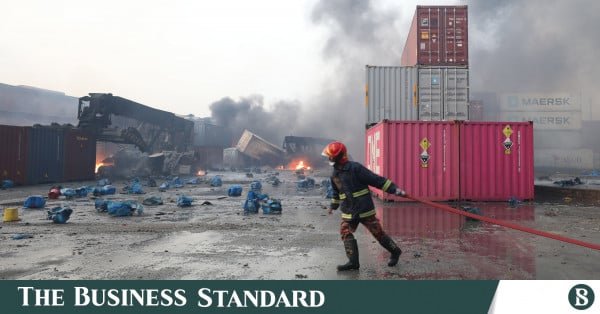
A devastating explosion at BM Container Depot in Sitakunda, Chattogram on 4 June 2022 killed at least 51 people, including 13 firefighters, injured around 300 others, and continues to raise questions over unidentified victims, compensation, and accountability. Photo: Mohammad Minhaj Uddin/TBS
“>

A devastating explosion at BM Container Depot in Sitakunda, Chattogram on 4 June 2022 killed at least 51 people, including 13 firefighters, injured around 300 others, and continues to raise questions over unidentified victims, compensation, and accountability. Photo: Mohammad Minhaj Uddin/TBS
Four years after the catastrophic explosion at BM Container Depot in Chattogram’s Sitakunda that officially killed 51 people, including 13 firefighters, nine victims still remain unidentified, raising fresh questions about the true death toll and accountability for one of Bangladesh’s deadliest industrial disasters.
The 4 June 2022 explosion injured around 300 people and exposed serious failures in the handling of hazardous chemicals. Yet many injured workers say they never received compensation, while conflicting official investigations have left key questions unresolved.
A government probe blamed depot authorities, the exporter and multiple regulatory failures. A later police investigation cleared all accused depot officials, describing the incident as an accident. Survivors and rights activists allege influential political connections helped shield the owners from accountability.

Unidentified victims and the Rohingya question
Nine victims remained unclaimed despite DNA testing, public notices and months of investigation. Their remains were buried in December 2022 following a court order.
Survivors and locals believe some may have been Rohingya refugees employed informally through contractors.
Nayan Barua, a survivor who worked in the depot canteen, told The Business Standard that around 300 Rohingyas worked at the facility and at least 100 were inside on the night of the explosion. “The unidentified bodies are most probably of Rohingya workers,” he said.
Tea stall owner Mohammad Selim said many Rohingya workers disappeared after the accident. Chattogram district Sujan General Secretary Advocate Akhtar Kabir Chowdhury said the allegations warrant further investigation because undocumented refugees would have faced major barriers to DNA matching and legal claims.
A senior government official involved in the BM Depot investigation, speaking anonymously, also acknowledged the possibility.
He said Rohingyas are often employed in factories for lower wages and that deaths outside the camps can go unreported and unclaimed when families lose contact. No government agency has officially confirmed whether Rohingya refugees worked at the depot.
Survivors still waiting for justice
Nayan remains haunted by the blast. Standing about 200 metres from a burning container, he was struck by a chemical-filled jerrycan hurled by the explosion and thrown nearly 20 feet into a roadside drain. An iron rod pierced his back, trapping him for almost two hours.
“People whose bodies were on fire were running in every direction. Everyone was trying to save their lives, but there was no one to help,” he recalled.
He said a colleague, Shoaib from Banshkhali, was killed and never found, though his family later received Tk10 lakh in compensation.
Injured worker Nur Hosen Didar said around 30 workers received no compensation despite repeated appeals. He permanently lost vision in one eye and still struggles to walk.
A disaster foretold
A government probe led by then Additional Divisional Commissioner Mohammad Mizanur Rahman concluded that unsafe chemical storage, inadequate safety measures and regulatory failures caused the disaster.
Investigators found that 37 containers of hydrogen peroxide produced by Al-Razi Chemical Industries – a company linked to the depot owners – had been stored for nearly 40 days in extreme summer heat.
Pressure built up inside plastic jerrycans, causing leakage, heat generation and eventually a fire that triggered a massive explosion about an hour later.
The committee found warning signs had already emerged. Days before the disaster, a shipment of hydrogen peroxide from the same manufacturer caught fire at Cambodia’s Sihanoukville Port.
Authorities were informed and instructed on 2 June 2022 to return five containers to the factory. They were never removed. Two days later, the explosion occurred.
Two investigations, two conclusions
The government probe held BM Depot authorities, Al-Razi Chemical Industries, shipping companies and regulators responsible for unsafe chemical storage, inadequate firefighting systems, poor worker training and weak oversight.
The criminal investigation reached the opposite conclusion. Police charged eight depot officials over alleged negligence and safety violations, but in April 2023, Detective Branch Inspector Mostak Ahmed Chowdhury recommended discharging all accused, finding no evidence of criminal negligence.
A court accepted the report the following month and closed the case.
The police report claimed firefighters knew hazardous chemicals were stored at the depot but lacked the expertise and equipment to respond. Fire Service officials rejected the claim.
Rakib Hasan Bappi, one of only three surviving members of the first responding unit, said firefighters were never informed about the chemicals.
Assistant Director of Fire Service Anwar Hossain said proper disclosure would have triggered evacuation and hazardous-material protocols. The disaster killed 13 firefighters and injured 18 others.
TBS sought comments from BM Container Depot on responsibility for the disaster, Rohingya employment allegations and unpaid compensation claims. Repeated calls, SMS and WhatsApp messages to director Mujibur Rahman went unanswered, while company representatives declined official comment.
About The Author