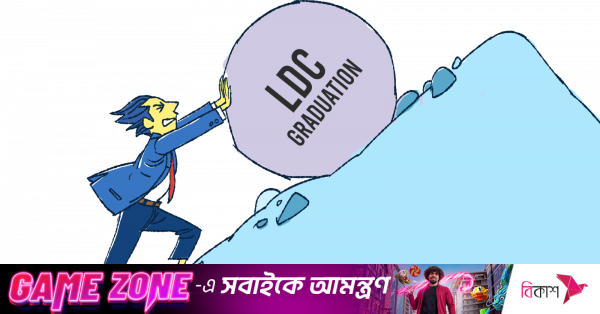
The UN Committee for Development Policy (CDP) has recommended that the United Nations General Assembly extend Bangladesh’s preparatory period for graduation from the least developed country category until 24 November 2029, granting the country an additional three years beyond the original timeline.
According to an Economic Relations Division (ERD) statement issued today (2 June), the recommendation follows Bangladesh’s formal request submitted on 18 February 2026 and a subsequent letter from the prime minister to the UN secretary-general on 6 April.
The CDP noted, however, that Bangladesh continues to exceed the graduation thresholds by a wide margin across all three LDC criteria, leaving little risk of the country falling back below those benchmarks in the near or medium term.

Despite this strong performance, the committee acknowledged that a series of external shocks, including the recent Middle East crisis, global energy and supply chain disruptions, and evolving international trade dynamics, could affect the country’s preparedness for a smooth transition from LDC status.
CDP Chair José Antonio Ocampo stressed that the extension should not be viewed as an opportunity to postpone reforms. Rather, he said, it should be used to accelerate efforts to address key structural challenges.
According to the committee, Bangladesh must make significant progress in ensuring financial sector stability, boosting tax revenue and domestic resource mobilisation, strengthening productive capacity and economic diversification, and preparing the private sector for the post-graduation environment.
If approved by the UN General Assembly, the extension will provide Bangladesh with additional time to implement its smooth transition strategy and adapt to the eventual withdrawal of preferential market access and other international support measures available to LDCs.
The CDP also underscored the need for continued international support during both the preparatory and post-graduation phases, including concessional financing, technical assistance, stronger trade negotiation capacity, and an appropriate extension of LDC-specific support measures.
About The Author