Experts and disaster management stakeholders have called for the introduction of an integrated early warning dissemination platform in Bangladesh to improve coordination among agencies and ensure faster, more reliable delivery of disaster alerts during climate-related emergencies.
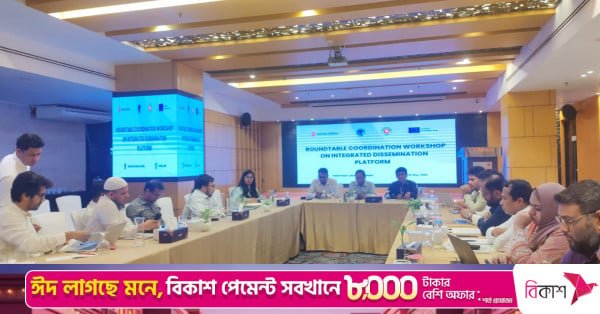
The call came at a roundtable on the Integrated Dissemination Platform (IDP), jointly organised by Save the Children and RIMES with support from the European Civil Protection and Humanitarian Aid Operations in the capital today (23 May).
Participants said the proposed platform could strengthen Bangladesh’s early warning system by enabling consistent and multi-channel dissemination of alerts for floods, cyclones, flash floods, heatwaves, landslides and other climate-related hazards.

A major focus of the discussion was the Common Alerting Protocol (CAP), an internationally recognised XML-based digital standard presented by RIMES. According to the presentation, CAP allows authorised hazard warnings to be transformed into unified messages and distributed simultaneously through SMS, voice calls, mobile apps, social media and sirens.
Nitai Chandra Dey Sarkar, director (MIM) at the Department of Disaster Management, said multiple warning sources often create confusion among communities.
“An integrated system can help minimise damage and losses by ensuring people receive clear and coordinated alerts,” he said.
Md Manzur Rahman, executive engineer at the Flood Forecasting and Warning Centre under the Bangladesh Water Development Board, said integrated dissemination would help reduce misinformation and communication gaps during disasters.
Director General of the Department of Disaster Management Razwanur Rahman, who attended the event as chief guest, said the proposed platform would complement and modernise the country’s existing warning dissemination system.
“We are hopeful that IDP will help Bangladesh move closer to achieving the commitment of ‘Early Warning for All’,” he said.
The workshop brought together representatives from the Department of Disaster Management, the Flood Forecasting and Warning Centre, the Department of Agricultural Extension, international NGOs, and telecom operators including Grameenphone to address gaps and fragmentation in the country’s warning dissemination system.
Speakers at the workshop noted that while Bangladesh has made significant progress in disaster preparedness, impact-based forecasting, and anticipatory action, warning dissemination still depends on multiple agency-specific systems that often lead to inconsistent messaging and delayed outreach.
They said an Integrated Dissemination Platform could connect authorised hazard information providers, telecom operators, media outlets, and local dissemination mechanisms through a common interoperable system, helping deliver timely and reliable warnings to communities at risk.
About The Author