Despite aggressive discounts offered by major fashion retailers, many businesses say customer turnout has fallen below expectations.
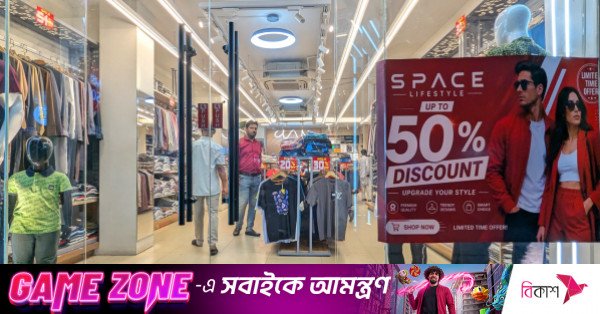
Discount banners hang at a clothing store in Dhaka as retailers offer Eid sales to attract customers. Traders say cautious spending and reduced footfall have slowed business this season. Photo: TBS
“>

Discount banners hang at a clothing store in Dhaka as retailers offer Eid sales to attract customers. Traders say cautious spending and reduced footfall have slowed business this season. Photo: TBS
Glittering “Flat 50% Off” banners stretch across storefronts, sales staff stand idle beside neatly arranged clothing racks, and once-bustling shopping malls in Dhaka are seeing noticeably thinner crowds this Eid season.
Highlights: TBS
“>

Highlights: TBS
Despite aggressive discounts offered by major fashion retailers, many businesses say customer turnout has fallen below expectations.
Traders across the capital’s key retail hubs describe a sluggish shopping season marked by weak sales, cautious spending, and reduced evening footfall.
While most retailers are avoiding outright losses, many say profit growth has stalled compared with previous years, raising concerns about changing consumer behaviour and broader economic pressures.

At Infinity on Bailey Road, manager Shahriar Sultan said this season’s business has not met expectations.
“Compared to last year, fewer customers are coming this time. The crowd increases slightly in the evening compared to daytime, but sales are not very profitable. Our branch is doing relatively well, but the situation in other showrooms is not very good,” he said.
Retailers say Eid shopping, once characterised by excitement, impulse buying and crowded late-night shopping trips, now reflects a more cautious reality shaped by inflation, rising living costs and reduced disposable income among middle-class families.
At Artisan, manager Dipta Das attributed the slowdown to both environmental and economic factors.
“I believe the extreme heat and the country’s economic situation are the reasons behind the lower number of customers,” he said.
Noting the previous operational time limits, he added that even after the rules were relaxed, customer footfall after 8pm has remained significantly lower than last year.
At Bashundhara Shopping Mall, retailers reported a similar trend. Jisan, a sales employee at Gentle Park, said customer turnout has dropped noticeably this season.
“Sales increase a little at night, but we have to close everything by 10pm. Most customers usually come after the evening. Extending shopping hours during Eid would be better for everyone,” he said.
Retailers also said that despite offering higher discounts than in previous years, many consumers are prioritising essential expenses over festive shopping.
Some visitors come only to compare prices, while others delay purchases in anticipation of deeper discounts closer to Eid.
Economic pressure and changing spending habits
Economists say the slowdown reflects broader economic pressures affecting household spending.
Ashikur Rahman, chief economist at the Policy Research Institute of Bangladesh, said prolonged inflation and external shocks have weakened consumer confidence.
“There has been a sense of panic since the war and due to prolonged inflation over a long period,” he said. “People may have reduced non-essential buying. Private sector credit growth has fallen to 4.7%. Over the past 12 months, imports and exports have remained under pressure.”
He added that economic reforms need to be implemented effectively to help restore stability.
From a marketing perspective, experts say the issue is less about promotional strategies and more about changing consumer priorities and purchasing power.
Mubina Khondkar, professor at the Department of Marketing at the University of Dhaka, said discounts alone are no longer enough to drive demand.
“People’s purchasing power is acting as a factor from an economic perspective. Consumers tend to maintain loyalty toward certain brands where discounts do not really work. In such cases, the reference value of brands offering discounts may shrink,” she said.
She also pointed to the growing influence of online platforms and emerging fashion brands that offer greater variety and convenience.
Rising costs squeeze discretionary spending
Selim Raihan, professor of economics at the University of Dhaka and executive director of the South Asian Network on Economic Modeling, said rising prices of essential goods are forcing households to reduce discretionary spending.
“The prices of daily necessities have increased significantly, so many families are trying to reduce extra spending, including shopping for Eid clothes,” he said. “Even if brands are offering attractive discounts, customers are now more careful with their expenses.”
He added that shorter shopping hours and the expansion of online retail options are also contributing to lower footfall at physical stores.
Retailers see shift in consumer priorities
Retail managers say Eid-ul-Azha brings different spending priorities compared with other festive seasons.
“During Eid-ul-Azha, customers naturally become more value-conscious as spending priorities shift toward Qurbani,” said Md Sadequzzaman Khan, senior manager of brand and marketing at Sailor.
“As a result, lifestyle and luxury purchases shift to a secondary priority. Discounts alone are not enough to drive significant growth for fashion and lifestyle brands, as purchases typically follow essential spending.”
He said earlier restrictions on shopping hours, particularly the 7pm closing limit, had a noticeable impact on retail performance.
“We observed earlier 7pm closing restrictions significantly hurt retail performance,” he said. “From 12 May onward, relaxed hours and improved mobility ahead of Eid supported the gradual recovery of Sailor’s sales, though industry-wide challenges remained.”
However, he said consumer preferences are gradually changing.
“A positive shift is evident: consumers are less driven by discounts and increasingly prefer newness, design innovation, fabric differentiation, and fresh collections,” he said. “While pricing still matters, design appeal, product quality, and overall brand experience now play a stronger role in purchase decisions.”
For many retailers, the coming days will determine whether the Eid season ends with a partial recovery or a continued slowdown.
About The Author