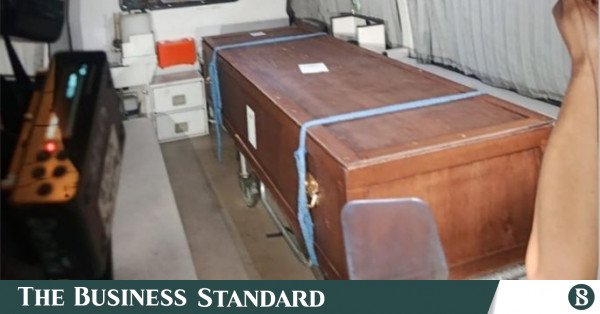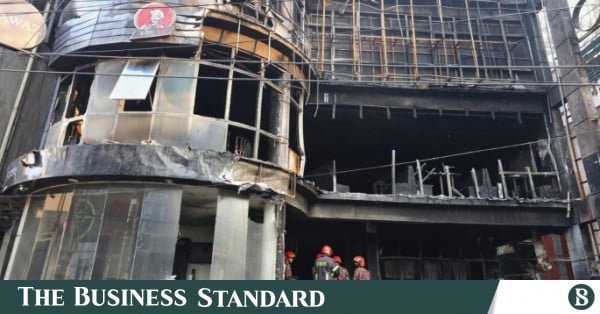
A devastating fire at Green Cozy Cottage on Dhaka’s Bailey Road that killed 46 people was allegedly worsened when the main gate of a restaurant was locked to prevent customers from leaving without paying their bills.
Two years after the incident on 29 February 2024, the Criminal Investigation Department (CID) has submitted a chargesheet to the court accusing 22 people – including restaurant owners and managers – of negligence and criminal misconduct.
According to the investigation, the fire broke out around 9:45pm at a ground-floor coffee shop named Chayer Chumuk, reportedly from an electric kettle. Within minutes, flames and thick smoke spread throughout the eight-storey building, which housed at least 10 restaurants operating without proper approvals.

One of the worst-hit spots was a second-floor restaurant called Kacchi Bhai, which had offered special discounts for “Leap Year,” attracting an unusually large crowd that evening.
As panic spread and customers rushed to escape, investigators say the restaurant’s authorities locked the main gate to prevent customers from leaving without settling their bills. The rooftop gate was also found locked.
Dozens of people became trapped inside the restaurant, where smoke quickly filled the space. Most victims died from suffocation rather than burns. Of the 46 victims, three were burned to death and 43 died from inhaling smoke.
The chargesheet, submitted yesterday by CID Inspector Shah Jalal Munshi, details a series of violations and systemic failures. It alleges that the accused operated restaurants without valid licences, ignored safety regulations, and used gas cylinders and electric ovens in hazardous conditions.
Two accused were recommended for discharge due to death, while two others were cleared due to lack of evidence.
Speaking to The Business Standard, Supreme Court lawyer and Additional Public Prosecutor Muhammad Shamsuddoha Sumon said the building owner, restaurant owners and managers were all involved in violating safety regulations. That is why 22 people have been charged.
Investigators found that although the building had approval for commercial use up to five floors, all eight floors, including the rooftop, were used for business purposes. The rooftop also had an illegal duplex restaurant.
The entire structure lacked basic fire safety measures. There was no proper ventilation system, and stairways, meant to serve as emergency exits, were obstructed with gas cylinders and stored goods.
Highly flammable materials were used extensively in interior décor, allowing the fire to spread rapidly.
“The fire started on the ground floor but quickly engulfed the entire building,” Sumon said. “People tried to escape, but smoke spread faster than the flames. Many were trapped before they could find a way out.”
He added that when people were trying to flee, they had neither the time nor the ability to pay bills.
“Everyone was trying to save their lives. But the gate was locked. That is why so many people were trapped inside Kacchi Bhai. Initially, there was smoke, not fire. People became unconscious from the smoke and died,” he said.
According to investigators, many commercial establishments in Dhaka operate without proper oversight, often ignoring fire safety standards. In this case, none of the 10 restaurants in the building had valid documentation, the chargesheet noted.
The lack of ventilation, locked exits, and blocked stairways created a death trap for those inside.
The next hearing in the case, for charge framing, is scheduled for 19 April. Prosecutors say they will pursue the case strongly.
“We will bring all accused under charges and present strong evidence,” Sumon said. “We want exemplary punishment for those responsible for such inhuman actions.”
However, the accused have denied the allegations.
Contacted by phone, Sohel Siraj, owner of Kacchi Bhai, Khanaj, and Tawaj restaurants, said they had not yet received the chargesheet and only learned about it through media reports.
Rejecting the allegation of locking the gate, he said their staff had actively tried to rescue people during the fire.
“We uploaded several videos on our Facebook page showing our staff throwing gas cylinders down and trying to extinguish the fire. We also helped people climb down using ladders,” he said.
He questioned the allegation, saying: “Is it believable that we would lock our guests and employees inside during a fire? There was no gate-only a glass partition.”
About The Author